Forescout FSCP Questions Can Help you Pass Exam [2026]
Wiki Article
BONUS!!! Download part of Dumpkiller FSCP dumps for free: https://drive.google.com/open?id=1iqMIrGKU2bmCXhKxbCd1UFsWC9ECaatu
Our users are all over the world, and users in many countries all value privacy. Our FSCP simulating exam ' global system of privacy protection standards has reached the world's leading position. No matter where you are, you don't have to worry about your privacy being leaked if you ask questions about our FSCP Exam Braindumps or you pay for our FSCP practice guide by your credit card. It is safe for our customers to buy our FSCP learning materials!
Forescout FSCP Exam Syllabus Topics:
| Topic | Details |
|---|---|
| Topic 1 |
|
| Topic 2 |
|
| Topic 3 |
|
| Topic 4 |
|
| Topic 5 |
|
| Topic 6 |
|
| Topic 7 |
|
>> FSCP Reliable Test Notes <<
Forescout Certified Professional FSCP free valid dumps & Forescout FSCP actual pdf exam
With limited time for your preparation, many exam candidates can speed up your pace of making progress. Our FSCP study materials will remedy your faults of knowledge understanding. As we know, some people failed the exam before, and lost confidence in this agonizing exam before purchasing our FSCP training guide. Also it is good for releasing pressure. Many customers get manifest improvement and lighten their load with our FSCP exam braindumps. So just come and have a try!
Forescout Certified Professional Exam Sample Questions (Q45-Q50):
NEW QUESTION # 45
Which of the following is true regarding the Windows Installed Programs property which employs the "for any
/for all" logic mechanism?
- A. The condition does not have any sub-properties. The "any/all" refers to the multiple programs.
- B. Although the condition has sub-properties which could refer to a single program on multiple endpoints, the "any/all" refers to the program's properties.
- C. Although the condition has multiple sub-properties, the "any/all" refers to the programs and not the sub- properties.
- D. Although the condition has multiple sub-properties, the "any/all" refers to the sub-properties and not the programs.
- E. Although the condition has multiple sub-properties, when "ANY" is selected it evaluates the programs for any of the configured sub-properties.
Answer: C
Explanation:
Comprehensive and Detailed Explanation From Exact Extract of Forescout Platform Administration and Deployment:
The Windows Installed Programs property condition utilizes multiple sub-properties including Program Name, Program Version, Program Vendor, and Program Path. However, when using the "for ANY/for ALL" logic mechanism, the "any/all" refers to the PROGRAMS and not to the sub-properties.
How the "Any/All" Logic Works with Windows Installed Programs:
When configuring a policy condition with the Windows Installed Programs property, the "any/all" logic determines whether an endpoint should match the condition based on:
* "For ANY" - The endpoint matches the policy condition if ANY of the configured programs are installed on the endpoint
* "For ALL" - The endpoint matches the policy condition if ALL of the configured programs are installed on the endpoint Example: If an administrator creates a condition like:
* Windows Installed Programs contains "Microsoft Office" OR "Adobe Reader"
* Using "For ANY": The endpoint matches if it has EITHER Microsoft Office OR Adobe Reader installed
* Using "For ALL": The endpoint matches only if it has BOTH Microsoft Office AND Adobe Reader installed The sub-properties (Program Name, Version, Vendor, Path) are used to define and identify which specific programs to match against, but the "any/all" logic applies to the PROGRAMS themselves, not to the sub- properties.
Why Other Options Are Incorrect:
* A - Incorrectly states the "any/all" evaluates the programs for the sub-properties
* B - Factually incorrect; the condition definitely has multiple sub-properties (Name, Version, Vendor, Path)
* C - Confuses the scope; the "any/all" does not refer to "program's properties" but to multiple programs
* D - Inverted logic; the "any/all" refers to the programs, not the sub-properties Referenced Documentation:
* Forescout Administration Guide v8.3, v8.4
* Working with Policy Conditions - List of Properties by Category
* Windows Applications Content Module Configuration Guide
NEW QUESTION # 46
When using the "Assign to VLAN action," why might it be useful to have a policy to record the original VLAN?
Select one:
- A. Since CounterACT reads the startup config to find the original VLAN, network administrators saving configuration changes to switches could overwrite this VLAN information
- B. Since CounterACT reads the running config to find the original VLAN, network administrators making changes to switch running configs could overwrite this VLAN information
- C. Since CounterACT reads the running config to find the original VLAN, network administrators saving configuration changes to switches could overwrite this VLAN information
- D. Since CounterACT reads the running config to find the original VLAN, any changes to switch running configs could overwrite this VLAN information
- E. Since CounterACT reads the startup config to find the original VLAN, network administrators making changes to switch running configs could overwrite this VLAN information
Answer: D
Explanation:
According to the Forescout Switch Plugin documentation, the correct answer is: "Since CounterACT reads the running config to find the original VLAN, any changes to switch running configs could overwrite this VLAN information".
Why Recording Original VLAN is Important:
According to the documentation:
When CounterACT assigns an endpoint to a quarantine VLAN:
* Reading Original VLAN - CounterACT reads the switch running configuration to determine the original VLAN
* Temporary Change - The endpoint is moved to the quarantine VLAN
* Restoration Issue - If network administrators save configuration changes to the running config, CounterACT's reference to the original VLAN may be overwritten
* Solution - Recording the original VLAN in a policy ensures you have a backup reference Why Option D is the Most Accurate:
Option D states the key issue clearly: "any changes to switch running configs could overwrite this VLAN information." This is the most comprehensive and accurate statement because it acknowledges that ANY changes (not just those by administrators specifically) could cause the issue.
NEW QUESTION # 47
Which type of signed SSL Certificate file formats are compatible with CounterACT?
- A. .Pckcs#7, .pckcs#12
- B. .p7b, .pem
- C. .Pfx/.p12, .Pfx/.p7
- D. .cer, .crt
- E. .X.509, x.507
Answer: B
Explanation:
Comprehensive and Detailed Explanation From Exact Extract of Forescout Platform Administration and Deployment:
According to the Forescout CLI Reference - Generating CSRs and Importing Signed Certificates documentation, the SSL certificate file formats compatible with CounterACT are ".p7b" and ".pem".
Supported Certificate Formats:
According to the CLI Reference documentation:
"To import a certificate from DER or P7B formatted files, convert it to PEM file format. Then convert the PEM files to a single PFX file as described above." This indicates that:
* P7B format - Supported (PKCS#7 container format)
* PEM format - Supported and widely used (ASCII-encoded format)
Certificate Format Conversion Process:
According to the documentation:
The standard import process is:
text
Original Format # Conversion # PEM Format # PFX Format # Import to CounterACT
## DER files # Convert # PEM
## P7B files # Convert # PEM
## PEM files # Direct use or convert to PFX
Why Other Options Are Incorrect:
* A. .Pfx/.p12, .Pfx/.p7 - Pfx is the final format used, not input; p7 is not a standard format
* C. .X.509, x.507 - X.509 is a standard (not a format); x.507 is not valid
* D. .Pckcs#7, .pckcs#12 - Spelling is "PKCS," not "Pckcs"; these are standards, not file formats
* E. .cer, .crt - These are certificate formats but not listed as directly compatible in the documentation Certificate Import Workflow:
According to the documentation:
Compatible workflow formats:
* Input Formats (that need conversion):
* DER files # Convert to PEM
* P7B files # Convert to PEM
* CER files # Convert to PEM
* Intermediate Format:
* PEM (ASCII-encoded, universally compatible)
* Final Format:
* PFX (used for CounterACT import)
Referenced Documentation:
* Generating CSRs and Importing Signed Certificates - CLI Reference
* Import and Configure System Certificates
NEW QUESTION # 48
Which of the following best describes why PXE boot endpoints should be exempt from Assessment policies?
- A. Because they are not yet manageable and may not have all the required software and services installed
- B. They have already been deployed and should immediately be subject to Assessment policies
- C. Because they are special endpoints playing a specific role in the network
- D. Because they will never be manageable or have the required software and services
- E. Because they will not be subject to the Acceptable Use Policy
Answer: A
Explanation:
Comprehensive and Detailed Explanation From Exact Extract of Forescout Platform Administration and Deployment:
PXE (Preboot Execution Environment) boot endpoints should be exempt from Assessment policies because they are not yet manageable and may not have all the required software and services installed. According to the Forescout Administration Guide, endpoints in the early stages of deployment, such as those booting via PXE, are temporary in nature and lack the necessary management capabilities and required software components.
PXE Boot Endpoints Characteristics:
PXE boot endpoints represent machines in a temporary state during the deployment process:
* Not Yet Fully Deployed - PXE boot is used during initial OS installation and deployment
* Lack Required Services - The endpoint does not yet have installed:
* SecureConnector (if required for management)
* Endpoint agents
* Required security software
* Management services
* Limited Configuration - The endpoint may not have completed network configuration
* Temporary State - PXE boot endpoints are in a transient state, not their final operational state Policy Endpoint Exceptions:
According to the documentation, administrators can "select endpoints in the Detections pane and exempt them from further inspection for the policy that detected them". This is particularly important for PXE boot endpoints because:
* False Positives - Assessment policies might flag PXE boot endpoints as non-compliant due to missing software that hasn't been installed yet
* Blocked Deployment - If blocking actions are applied, they could interfere with the deployment process
* Temporary Assessment - Once the endpoint is fully deployed and manageable, it can be added back to Assessment policies
* Operational Efficiency - Exempting PXE boot endpoints prevents unnecessary policy violations during the deployment window Manageable vs. Unmanageable Endpoints:
According to the documentation:
"Endpoints are generally unmanageable if their remote registry and file system cannot be accessed by Forescout. Unmanageable hosts can be included in your policy." PXE boot endpoints specifically fall into this category because:
* Remote management is not yet available
* Required agents are not installed
* File system access is not established
Why Other Options Are Incorrect:
* A. Because they will not be subject to the Acceptable Use Policy - Not the primary reason; Assessment policies differ from Acceptable Use policies
* B. They have already been deployed and should immediately be subject to Assessment policies - Contradicts the purpose; PXE boot endpoints are NOT yet deployed
* D. Because they will never be manageable or have the required software and services - Incorrect; once deployed, they WILL become manageable
* E. Because they are special endpoints playing a specific role in the network - While true in context, this doesn't explain why they need exemption Referenced Documentation:
* Forescout Administration Guide - Create Policy Endpoint Exceptions
* Restricting Endpoint Inspection documentation
* Manage Actions - Unmanageable hosts section
NEW QUESTION # 49
When configuring policies, which of the following statements is true regarding the indicated property?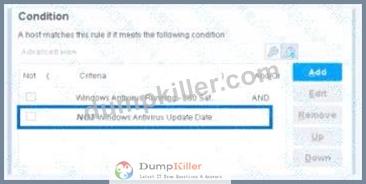
Select one:
- A. Negates the "evaluate irresolvable as" setting
- B. Negates the criteria outside the property
- C. Modifies the irresolvable condition to TRUE
- D. Irresolvable hosts would match the condition
- E. Negates the criteria inside the property
Answer: E
Explanation:
Based on the policy condition image provided showing the NOT checkbox on "Windows Antivirus Update Data", the correct statement is that the NOT operator negates the criteria inside the property.
Understanding the NOT Operator:
When the NOT checkbox is selected on a policy condition property, it performs a logical negation (NOT operation) on the criteria evaluation. According to the Forescout Administration Guide:
The NOT operator creates an inverted evaluation:
* Without NOT: "Windows Antivirus Update Data = [value]"
* Result: Matches endpoints where the property equals the specified value
* With NOT (as shown in the image): "NOT (Windows Antivirus Update Data = [value])"
* Result: Matches endpoints where the property does NOT equal the specified value How the NOT Operator Works:
The NOT operator negates the criteria inside the property:
* Criteria Evaluation - The property condition is evaluated normally first
* Negation Applied - The result is then inverted (TRUE becomes FALSE, FALSE becomes TRUE)
* Final Result - The endpoint matches only if the negated condition is true Example from the Image:
The image shows:
* First criterion: "Windows Antivirus Running - 360 Sat" (AND)
* Second criterion: "NOT Windows Antivirus Update Data" (checked)
This means:
* The endpoint must have Windows Antivirus Running = True (360 Sat)
* AND the endpoint must NOT have the Windows Antivirus Update Data property value (whatever was specified)
* The NOT negates the criteria inside the property condition
NOT vs. "Evaluate Irresolvable As":
According to the documentation, these are independent settings:
Setting
Purpose
NOT Checkbox
Negates the criteria evaluation (inverts the match logic)
Evaluate Irresolvable As
Defines how to handle unresolvable properties (when data cannot be determined) The NOT operator works inside the property evaluation, while "Evaluate Irresolvable As" is a separate setting that determines behavior when a property cannot be resolved.
Why Other Options Are Incorrect:
* A. Irresolvable hosts would match the condition - The NOT operator doesn't specifically affect how irresolvable properties are handled
* C. Negates the criteria outside the property - The NOT operator is internal to the property; it negates the criteria inside, not outside
* D. Modifies the irresolvable condition to TRUE - The NOT operator doesn't modify the "Evaluate Irresolvable As" setting; these are independent
* E. Negates the "evaluate irresolvable as" setting - The NOT operator and "Evaluate Irresolvable As" are separate; NOT doesn't affect or negate that setting Policy Condition Structure:
According to the Forescout Administration Guide:
A policy condition is structured as:
text
[NOT] [Property Name] [Operator] [Value]
Where:
* [NOT] - Optional negation operator (what the checkbox controls)
* [Property Name] - The property being evaluated
* [Operator] - The comparison operator (equals, contains, greater than, etc.)
* [Value] - The value to match against
When NOT is checked, it negates the entire criteria evaluation inside that property condition.
Referenced Documentation:
* Forescout Administration Guide v8.3
* Forescout Administration Guide v8.4
* Define policy scope documentation
* Forescout eyeSight policy sub-rule advanced options
NEW QUESTION # 50
......
You choosing Dumpkiller to help you pass Forescout certification FSCP exam is a wise choice. You can first online free download Dumpkiller's trial version of exercises and answers about Forescout Certification FSCP Exam as a try, then you will be more confident to choose Dumpkiller's product to prepare for Forescout certification FSCP exam. If you fail the exam, we will give you a full refund.
Latest FSCP Exam Questions Vce: https://www.dumpkiller.com/FSCP_braindumps.html
- Valid Dumps FSCP Sheet ???? Simulation FSCP Questions ???? New FSCP Test Discount ???? Search for ▛ FSCP ▟ and obtain a free download on “ www.examdiscuss.com ” ????Simulation FSCP Questions
- Simulation FSCP Questions ???? FSCP Reliable Practice Materials ???? New FSCP Test Discount ???? Enter ☀ www.pdfvce.com ️☀️ and search for ➤ FSCP ⮘ to download for free ????Exam Sample FSCP Online
- Simulation FSCP Questions ???? Relevant FSCP Questions ⭕ Reliable FSCP Test Simulator ???? Search for ➽ FSCP ???? and obtain a free download on ➤ www.verifieddumps.com ⮘ ????New FSCP Test Test
- Preparation FSCP Store ???? Simulation FSCP Questions ???? Reliable FSCP Test Objectives ???? Search for “ FSCP ” and download it for free on “ www.pdfvce.com ” website ????Simulation FSCP Questions
- 100% Pass Quiz 2026 Forescout FSCP The Best Reliable Test Notes ???? Copy URL ▶ www.practicevce.com ◀ open and search for ▶ FSCP ◀ to download for free ⏪Exam Sample FSCP Online
- New FSCP Test Discount ???? Instant FSCP Access ???? Valid Dumps FSCP Sheet ???? Copy URL 《 www.pdfvce.com 》 open and search for { FSCP } to download for free ????Preparation FSCP Store
- FSCP dumps PDF - FSCP exam guide - FSCP test simulate ???? Search for 【 FSCP 】 and easily obtain a free download on ⮆ www.examcollectionpass.com ⮄ ????FSCP Reliable Exam Syllabus
- Valid Dumps FSCP Sheet ???? Relevant FSCP Questions ???? Instant FSCP Access ???? Copy URL ( www.pdfvce.com ) open and search for [ FSCP ] to download for free ????Valid Dumps FSCP Sheet
- 1 year Of Free Forescout FSCP Exam Questions Updates ???? ✔ www.prep4sures.top ️✔️ is best website to obtain ⮆ FSCP ⮄ for free download ????Preparation FSCP Store
- Instant FSCP Access ???? Exam Sample FSCP Online ???? FSCP Dumps Free ???? Easily obtain ➤ FSCP ⮘ for free download through ( www.pdfvce.com ) ????FSCP Latest Test Report
- Pass FSCP Guide ???? New FSCP Test Test ‼ Preparation FSCP Store ???? Open ➥ www.pass4test.com ???? enter ➠ FSCP ???? and obtain a free download ????Preparation FSCP Store
- theresarswj102461.blogginaway.com, bookmarkhard.com, modernbookmarks.com, aishaccpq358169.wikirecognition.com, echobookmarks.com, ok-social.com, zaynvlhy393708.corpfinwiki.com, wavesocialmedia.com, zaynabksmu694314.bloggosite.com, aoifewwyq612827.ttblogs.com, Disposable vapes
P.S. Free & New FSCP dumps are available on Google Drive shared by Dumpkiller: https://drive.google.com/open?id=1iqMIrGKU2bmCXhKxbCd1UFsWC9ECaatu
Report this wiki page